

FABRIKKEN for Kunst og Design
A municipal laundry that became the country's largest artist house
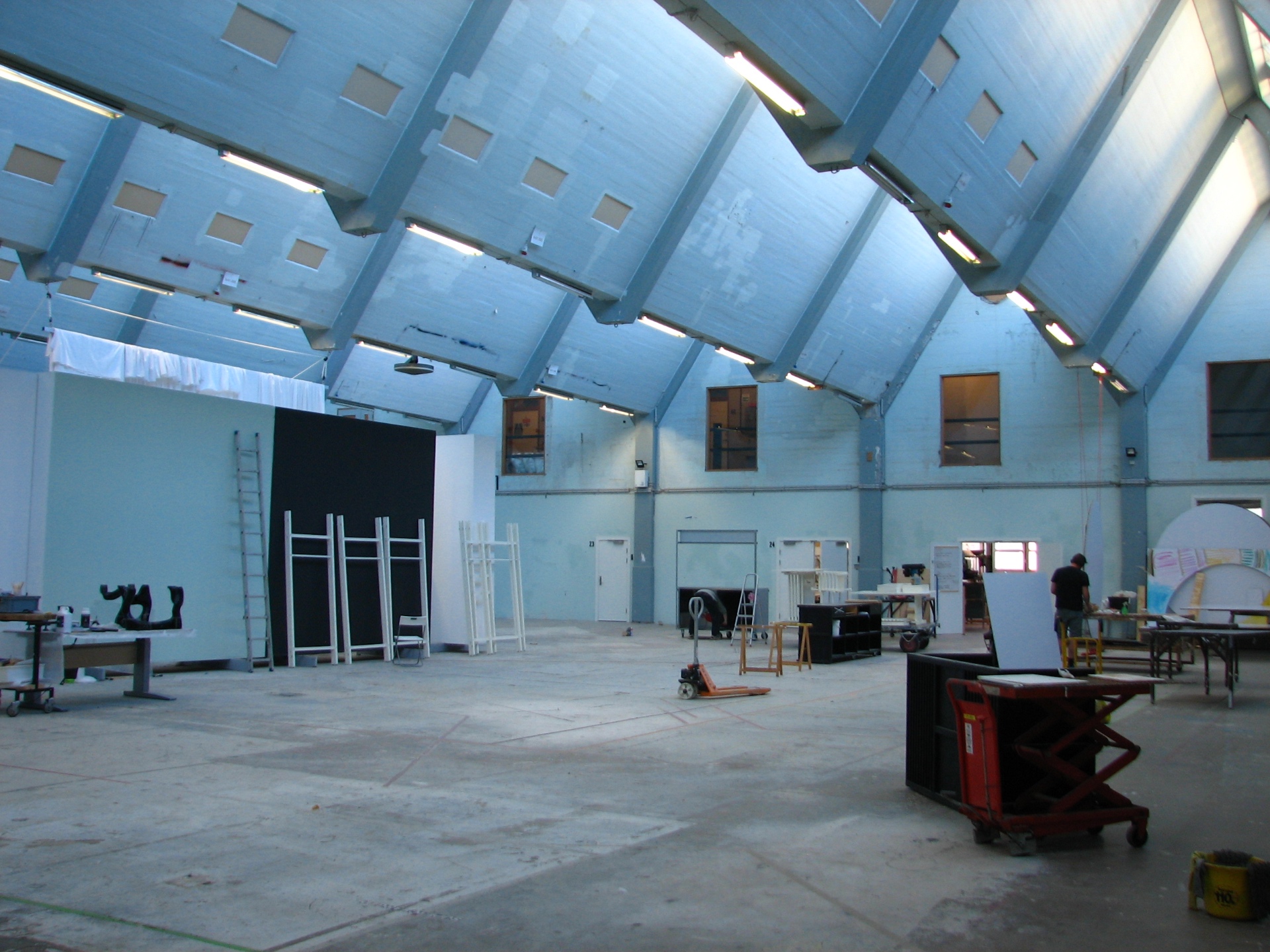
FABRIKKEN occupies a building that once washed the city's linen and now houses the largest community of professional artists and designers in Denmark. Its history is the most distinctive origin story in this guide, because the first generation of artists did not simply move into the building. They helped rebuild it with their own hands. The relationship that grew between that community and the City of Copenhagen, patient, conditional and built on trust earned over years, is the heart of what this chapter has to offer.
At a glance
- Then
- Copenhagen's municipal central laundry
- Now
- FABRIKKEN, the largest studio building for artists and designers in Denmark
- Built
- Around 1939, by the city architect Poul Holsøe
- Cultural rebirth
- Established by the City of Copenhagen in 1991, first named Kulturfabrikken
- Owner and operator
- The City of Copenhagen, used by the FABRIKKEN foundation
- Scale
- 51 studios and a production hall of 1,000 square metres, around 70 to 80 artists
What it once was
The building rose around 1939 as the city's central laundry, designed by Copenhagen's city architect of the time, and for roughly fifty years it laundered the linen of the capital. By the 1980s it had closed, and, as happened across Copenhagen in those years, artists searching for cheap space began to move in and use it.
The practice worth passing on
What makes FABRIKKEN unusual is how the conversion was actually carried out. Rather than a renovation imposed from above, much of the work was organised as a form of job activation. In an era when long term public support was available, the arrangement became that anyone who wished to work in the building would also spend part of their time renovating it, learning real skills in the process. People could be paid, while on welfare, to improve the very place they worked in. Craftspeople, artists and local politicians organised it together, the City of Copenhagen formalised it as a foundation in 1991, and the old laundry slowly became a working art house. From the start the City made the building available without rent, and added an annual operating grant until 2000.
For a municipality holding a derelict building and a population of underused talent, the model folds three problems into a single solution. The building is restored, people gain skills and income, and a cultural institution is created, all from the same effort.
If you try to do everything for everyone you will do nothing for anyone.
Building careers, not only projects
Most residencies last from a few months to a couple of years, which is enough for a single project but rarely enough to develop a practice. FABRIKKEN deliberately takes the long view. An artist receives a permit for three years, renewable three times, for up to twelve years in the building. The result is the largest artist community in the country, with the longest tenure, and a remarkable spread of ages working side by side, from twenty two to eighty five. The exchange across generations is so free that, as the team likes to say, you often cannot tell whether a work in the hall was made by the youngest artist or the oldest.
The rule that keeps the house honest
A condition written into the agreement requires that the artists in the building reflect the artists of the city: the same balance of disciplines, of genders and of generations. Selection considers age only in that context. No one is too old or too young in the abstract; an applicant simply has to fit the field, work professionally and genuinely need the space. It is a quiet safeguard against a house slowly narrowing into a club of one kind of person.
A relationship built on give and take
The City owns the building, and the foundation has the right to use it strictly for the production of art, with no subletting, no businesses and no retail. In return for honouring a short list of obligations, chiefly five public events each year together with clear rules on who may work there and for how long, the foundation is otherwise free to do as it wishes inside, while the listed facade remains untouched. The trust this has built is measurable. Contract renewals, once required every three years, now run every ten, as the house has delivered on its promises and grown from 55 artists to nearly 80, relieving a genuine problem for a city that had lost many such spaces to demolition. A substantial application is now in progress to upgrade the building, not to polish it into something glossy but to fit more artists with better facilities.
Guidance for municipalities and operators
For owners and public authorities
A derelict building can become a cultural asset and a social programme at the same time, if the renovation itself is treated as an opportunity for training and employment. Offer security through a short, clear list of obligations rather than heavy supervision, and let trust earn longer agreements over time. A tenant that visibly solves a problem for the city should be rewarded with a longer horizon.
For operators
Be narrow about whom you serve. As the house puts it, if you try to do everything for everyone you will do nothing for anyone, and a single clear purpose is far easier to deliver and to defend. Keep an open and honest personal line to the authority that owns your building. Tell them your plans, your ideas and your problems, even when you are under no obligation to, because they are the people you will turn to when something goes wrong. And do not mix the amateur with the professional, in your work or in your message.
Today
Between seventy and eighty professional artists and designers work here across painting, sculpture, ceramics, glass, furniture and performance, anchored by a vast self supporting concrete hall. International residency programmes, which have welcomed close to two hundred visiting artists since 2007, help fund the house and connect the Danish scene to the wider world. The building stands at Sundholm, on Amager.
Sources: FABRIKKEN for Kunst og Design; Art Matter; interview transcript, on site, May 2026. The attribution of the original architect, Poul Holsøe, then Copenhagen's city architect, is reconstructed from the interview and should be confirmed before publication. Photography by Zala and Pol.